
Can AI Replace BIM Engineers? The Real Future of BIM Engineering

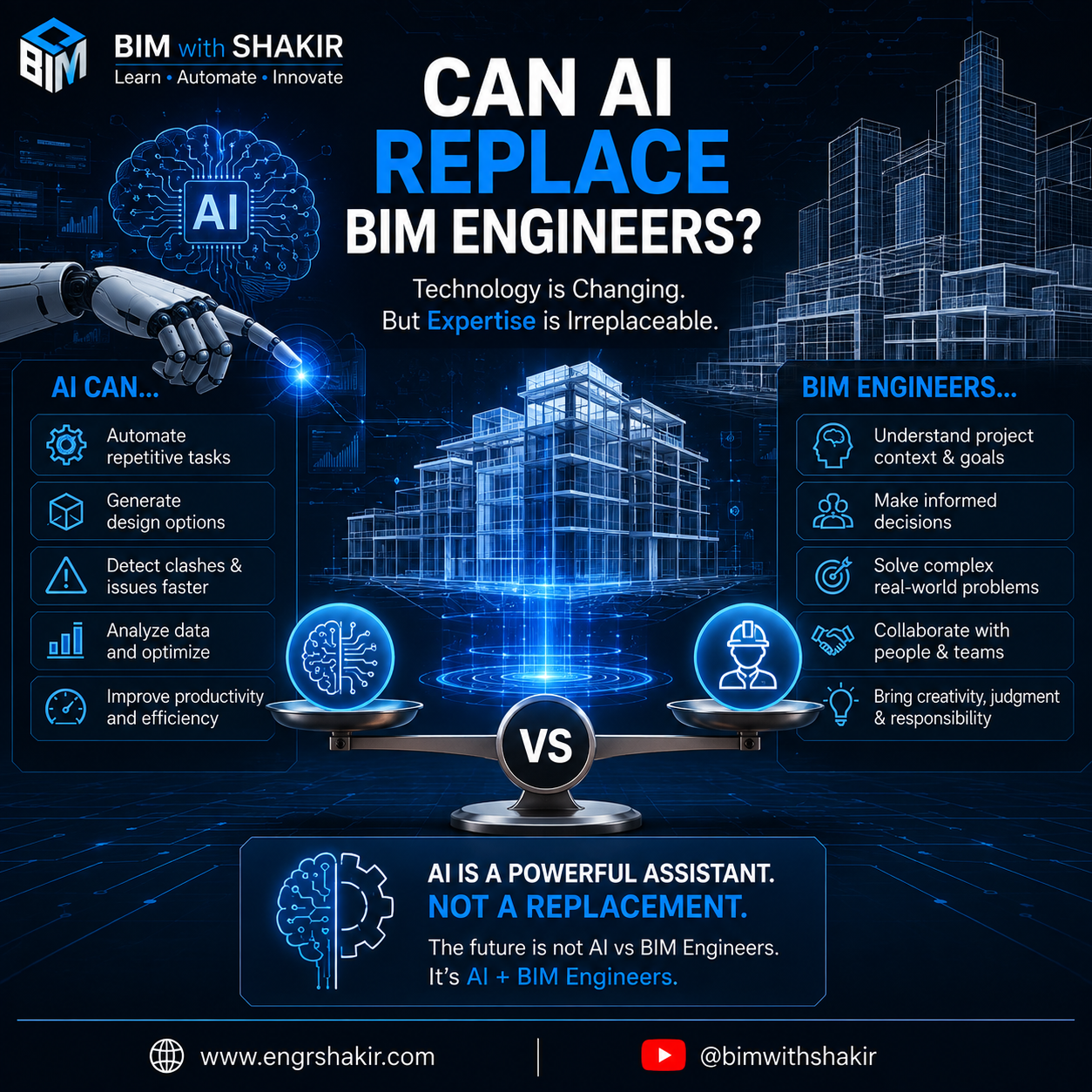
Can AI Replace BIM Engineers? The Real Future of BIM Engineering
Artificial Intelligence is changing the way BIM professionals work. From automating repetitive tasks to analyzing model data and identifying potential issues, AI is becoming increasingly powerful across the Architecture, Engineering, and Construction (AEC) industry.
But this raises an important question:
Can AI Replace BIM Engineers?
The short answer is: AI can replace some tasks, but replacing the BIM engineer is a much bigger challenge.
BIM engineering is not simply about creating a 3D model. It involves understanding project requirements, interpreting design intent, coordinating multiple disciplines, solving real-world problems, managing information, communicating with project teams, and making informed decisions.
That is why the future of BIM is more likely to be AI + BIM Engineers rather than AI replacing BIM engineers.
What Can AI Do in BIM?
AI can already support many activities that traditionally required significant manual effort.
1. Automate Repetitive Tasks
BIM workflows often contain repetitive activities such as data processing, information extraction, model checking, documentation, and routine quality-control tasks.
AI and automation can reduce the amount of manual effort required for these processes.
This allows BIM professionals to spend more time on engineering decisions and complex project requirements.
2. Analyze BIM Data
BIM models contain large amounts of structured information.
AI can help analyze this information, identify patterns, highlight anomalies, and support professionals in finding relevant information more efficiently.
However, analysis is only useful when the results are interpreted correctly within the context of the project.
3. Detect Potential Issues
AI can assist with identifying inconsistencies, missing information, potential clashes, and other issues that may require attention.
This can make model review and quality-control workflows faster.
But faster detection does not eliminate the need for professional review. Someone still needs to determine whether an issue is actually important and what should be done about it.
4. Generate Design Options
AI can help explore different design possibilities based on defined requirements and constraints.
But generating an option is not the same as approving an option.
BIM engineers and other project professionals still need to evaluate constructability, coordination, standards, project requirements, cost, performance, and practical implications.
What Does a BIM Engineer Actually Do?
This is where the discussion becomes more interesting.
A BIM engineer’s value is not limited to operating BIM software.
A BIM engineer may be responsible for:
- Understanding project requirements
- Interpreting design intent
- Developing and managing BIM models
- Coordinating multiple disciplines
- Identifying and resolving complex issues
- Managing BIM information
- Reviewing model quality
- Supporting project teams
- Making informed technical decisions
- Communicating with different stakeholders
- Applying professional judgment
These responsibilities require context.
And context is one of the biggest reasons why AI should be viewed as a powerful tool rather than an automatic replacement for professional expertise.
AI Can Generate Answers. Engineers Understand Consequences.
One of the biggest misconceptions about AI is that producing an answer is the same as understanding a problem.
Consider a complex BIM coordination issue.
AI may be able to identify a potential conflict between building systems. But the engineer still needs to understand:
- Which system has priority
- What the project requirements are
- Whether the conflict is actually constructible
- What impact a change will have on other disciplines
- Whether the proposed solution is practical
- Who needs to approve the change
- What information needs to be updated
The technical answer is only one part of the problem.
Engineering judgment determines what should happen next.
Will AI Replace BIM Jobs?
Some BIM tasks will almost certainly become more automated.
That does not automatically mean BIM engineering will disappear.
Instead, the role of the BIM professional may evolve.
Imagine a BIM engineer who previously spent several hours every week performing repetitive model checks.
If automation can handle much of that process, the engineer can spend more time on:
- Complex coordination
- Model strategy
- Design reviews
- Information management
- Problem-solving
- Workflow improvement
- Communication with project teams
In this situation, AI does not necessarily remove the engineer.
It changes what the engineer spends time doing.
The BIM Engineer of the Future
The BIM professional of the future may need a broader skill set than simply knowing how to use BIM software.
A powerful combination could be:
BIM Knowledge + Engineering Understanding + Automation + AI + Data + Problem-Solving
Professionals who understand both BIM workflows and emerging technologies will be better positioned to identify where AI can actually create value.
Why BIM Knowledge Becomes Even More Important
As AI becomes easier to use, understanding the underlying BIM process becomes even more important.
If you do not understand BIM, you may not know:
- Which task should be automated
- Which information is reliable
- Whether an AI-generated result is technically reasonable
- What needs human verification
- What impact a change could have on the wider project
AI can make processes faster.
But speed without understanding can also make mistakes happen faster.
How BIM Engineers Can Prepare for AI
You do not need to become an AI researcher to benefit from AI.
Start with your existing BIM workflow.
Step 1: Identify Repetitive Work
Look at the tasks you perform repeatedly every week.
Step 2: Find Automation Opportunities
Ask yourself:
“Can this task be automated?”
Tools such as Dynamo, scripting, APIs, and AI-based solutions may help.
Step 3: Learn How to Verify AI Results
Never assume that an AI-generated result is automatically correct.
Review the output against project requirements, BIM standards, engineering principles, and real-world constraints.
Step 4: Focus on Higher-Value Skills
As repetitive work becomes automated, develop skills that technology cannot easily replace, including:
- Critical thinking
- Problem-solving
- Coordination
- Communication
- Engineering judgment
- Project understanding
- Decision-making
AI vs BIM Engineers?
Perhaps this is the wrong question.
The more useful question is:
How Can BIM Engineers Use AI to Become More Effective?
AI can provide computational power, automation, data analysis, and assistance with repetitive work.
BIM engineers provide context, professional judgment, coordination, creativity, problem-solving, and responsibility.
Put them together and the result can be a much more powerful workflow.
The Future Is AI + BIM Engineers
The future of BIM is unlikely to be about humans competing directly against machines.
It is more likely to be about professionals learning how to use increasingly capable tools.
AI is a powerful assistant.
It is not automatically a replacement for engineering expertise.
The BIM engineers who embrace automation, understand AI, and continue developing their engineering and coordination skills can position themselves for the next generation of digital construction.
Final Thoughts
AI will change BIM engineering.
Some repetitive tasks will become automated. Some workflows will become faster. Some traditional responsibilities will evolve.
But BIM engineering is much more than model production.
It requires people who can understand project context, coordinate information, solve problems, communicate with teams, evaluate alternatives, and make informed decisions.
So, can AI replace BIM engineers?
AI may replace some BIM tasks.
It may transform some BIM roles.
But the biggest opportunity is for BIM professionals who learn how to work with AI rather than compete against it.
The future is not AI vs BIM Engineers.
The future is AI + BIM Engineers.
Frequently Asked Questions
Can AI completely replace BIM engineers?
AI can automate many BIM-related tasks, but BIM engineering also requires project understanding, coordination, problem-solving, professional judgment, and responsibility.
Will AI reduce BIM jobs?
AI may reduce the need for some repetitive manual tasks. At the same time, it can create new opportunities for professionals with BIM, automation, data, and AI skills.
Should BIM engineers learn AI?
Yes. BIM professionals can benefit from understanding how AI and automation can improve their workflows and productivity.
Should BIM engineers learn programming?
Programming is not required for every BIM role, but learning tools such as Dynamo, scripting, and APIs can significantly expand automation capabilities.
What should BIM engineers learn for the future?
Focus on BIM fundamentals, automation, AI literacy, data management, problem-solving, coordination, communication, and engineering judgment.
About BIM with Shakir
BIM with Shakir focuses on practical BIM education, automation, AI, and digital construction.
Learn • Automate • Innovate
▶ @bimwithshakir
What Do You Think?
Do you think AI will eventually replace some BIM engineering roles, or will it create a new generation of AI-powered BIM professionals?
Share your opinion in the comments.